2026-08-06 0
处理约束导致损失 18 个点,编译 Schema 挽回 14 个点这类问题时,先确认目标场景,再按步骤核对配置或玩法细节。

Posted on
#ai #machinelearning #llm #opensourceMy previous experiment ended with an uncomfortable result.
On the same 49 audited GSM8K questions, Qwen2.5-7B-Instruct answered 39 correctly
when prompted to produce JSON. When I enforced the declared schema with Outlines or
XGrammar, each backend answered only 30 correctly.
The constraints fixed compliance and cost 18.4 percentage points of recoverable
mathematical accuracy.
That result raised a more useful question than "are constraints bad?"
Was the model failing because it was constrained, or because the external contract
forced it through a poorly aligned lexical representation?
I have now completed the follow-up: 72 targeted and 150 full-confirmation generations
on Qwen2.5-7B, plus local integration probes, boundary traces, paired statistics, and
independent artifact validation.
The short result is this:
Replacing a model-facing signed numeric string with a native JSON integer, then
deterministically restoring the original string contract, improved both constrained
backends from 30/49 to 37/49 contract-valid correct.
That is a 14.3 percentage-point recovery while retaining 100% final external-schema
validity.
This article explains what changed, what stayed frozen, what the trace showed, and
why this is a Green light for a small contract-alignment compiler rather than proof of
a universal solution.
The first study is here:
Structured Output Fixed My JSON and Cut Math Accuracy by 18 Points.
All new code, raw rows, manifests, hashes, traces, and reports are in the repository.
A controlled, artifact-validated study of how JSON prompting, grammar-constrained decoding, and output-field order affect mathematical accuracy and schema compliance.
Results | Alignment result | Paired evidence | Study design | Reproduction | Evidence | Public Kaggle artifacts | Technical article | Limitations
Constrained decoding solved the formatting problem, but it did not preserve all of the model's recoverable mathematical accuracy. On Qwen2.5-7B, prompt-only JSON achieved 79.6% recoverable accuracy and 0% schema compliance. Outlines and XGrammar each achieved 61.2% recoverable accuracy and 100% schema compliance. The paired semantic effect was -18.4 percentage points for both backends (exact McNemar p = 0.003906).
This is not a claim that constrained decoding is universally harmful. It is a controlled reproduction showing that contract compliance and semantic correctness are separate outcomes, and that a decoder can improve the first while reducing the second under a specific, matched…
View on GitHubThe external schema required this:
{"reasoning": "...","answer": "18000"}
The model naturally preferred this:
{"reasoning": "...","answer": 18000}
The prompt-only output was valid JSON and often mathematically correct, but it did
not satisfy the contract because answer was a JSON number rather than a string.
Hard constraints solved that type mismatch. They also changed the generated answer.
In the frozen reasoning-first baseline:
| Condition | Semantic correctness | External-schema validity | Negative answers |
|---|---|---|---|
| Prompt-only JSON | 39/49 (79.6%) | 0/49 | 1/49 |
| Outlines signed string | 30/49 (61.2%) | 49/49 | 12/49 |
| XGrammar signed string | 30/49 (61.2%) | 49/49 | 12/49 |
Both constrained backends had the same paired transition against prompting:
correct in both:30correct only with prompting: 9correct only with constraints: 0wrong in both:10exact paired p: 0.003906
Eight of the nine losses were shared across Outlines and XGrammar. In seven shared
cases, the reasoning contained the correct positive magnitude and the final answer
field emitted its negative.
For example, the reasoning concluded 18000, then the constrained answer became
-18000.
That pattern suggested a representation problem at the answer boundary, not a reason
to build another grammar engine.
The caller's external contract remains authoritative. But the model does not
necessarily need to generate that exact wire representation directly.
The intervention was:
External contract{"reasoning": "...", "answer": "18000"}compile ↓Internal model-facing contract{"reasoning": "...", "answer": 18000}constrained generation ↓Deterministic transducerinteger 18000 -> canonical string "18000"external validation ↓Returned contract{"reasoning": "...", "answer": "18000"}
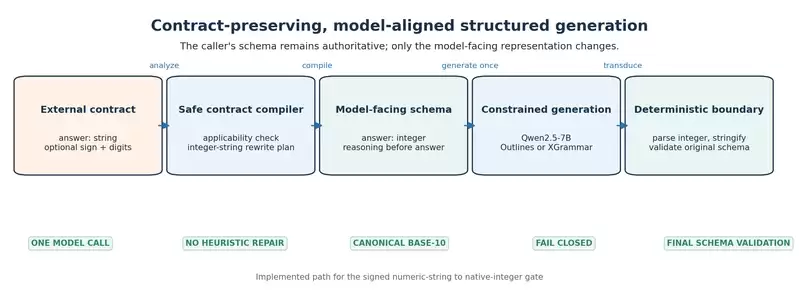
This design has four important properties:
The core transducer is deliberately boring:
def canonical_integer_string(value: object) -> str:if isinstance(value, bool) or not isinstance(value, int):raise TypeError("internal answer must be a JSON integer and not a boolean")return str(value)def transduce_integer_object(internal_value):if set(internal_value) != {"reasoning", "answer"}:raise ValueError("internal object must contain exactly reasoning and answer")if not isinstance(internal_value["reasoning"], str):raise TypeError("internal reasoning must be a string")return {"reasoning": internal_value["reasoning"],"answer": canonical_integer_string(internal_value["answer"]),}
After conversion, the rebuilt object is validated against the original signed
numeric-string schema. If parsing, typing, transformation, or external validation
fails, no external object is returned.
This is not post-hoc answer correction. The sign and magnitude generated by the
model are preserved exactly.
The gate question was frozen before launching the 7B intervention:
Does a native JSON integer as the hard-constrained, model-facing answer
representation recover the semantic losses observed with a signed numeric string,
while deterministic stringification restores validity under the original external
contract?
The Green criteria were:
The model, dataset, item order, chat template, greedy decoding, seed, FP32 precision,
256-token cap, and backend versions remained frozen.
Relative to the previous prompt, the integer prompt changed only the symbolic answer
representation:
signed-string template: "answer": "
A regression test compares the new prompt to the first accepted baseline row and
asserts that this replacement is the only change.
The experiment reports four separate outcomes:
This separation matters. A system that emits perfect JSON with the wrong number is
not successful. A mathematically correct response with the wrong API type is not
immediately usable either.
The primary product metric was contract-valid correctness after transduction.
I mechanically derived the targeted suite from the frozen baseline artifacts. It
contained:
The manifest recorded 9 Outlines losses, 9 XGrammar losses, 8 shared losses, and 10
unique losses across the two backends. The resulting suite had 18 items.
I ran four conditions:
The unsigned-string condition was useful because every gold answer in this subset
was positive. But it was not contract-equivalent: the original external schema permits
negative integers, so an unsigned internal language cannot be the general solution.
| Condition | Semantic correct | External valid |
|---|---|---|
| Prompted integer | 13/18 | 18/18 |
| Outlines integer | 13/18 | 18/18 |
| XGrammar integer | 13/18 | 18/18 |
| XGrammar unsigned-string diagnostic | 13/18 | 18/18 |
The aggregate tie hid useful paired information:
The result cleared the preregistered threshold to advance. It did not count as final
confirmation because the suite was deliberately enriched for known failures.
I wrapped the XGrammar Hugging Face logits processor and captured compact diagnostics
near the answer boundary. The trace records top pre-mask and post-mask candidates,
selected tokens, known sign and digit scores, and the number of masked vocabulary
entries. It does not store a full-vocabulary tensor.
Three items were traced:
gsm8k_test_173, a shared sign flip.gsm8k_test_1216, a backend-difference case.gsm8k_test_12, a matched control.For gsm8k_test_173, the generated reasoning ended with the correct value 18000.
At the integer answer boundary after whitespace:
token "1" pre-mask score:39.63token "-" pre-mask score:-1.33selected token: "1"
The integer grammar still permits legitimate negative values. The intervention did
not simply ban the minus sign. Instead, the changed representation exposed a token
path on which the digit was overwhelmingly preferred.
That is consistent with the hypothesis, but three traces are diagnostic evidence,
not a universal causal proof.
After the targeted gate passed, I ran the three integer conditions on the complete
frozen 50-item subset:
One contradictory GSM8K reference remained in every raw artifact and was excluded
only from the predeclared cleaned analysis. No other row was removed.
Independent validation accepted all 150 rows:
| Condition | Semantic correct | Contract-valid correct | External valid | Negative answers |
|---|---|---|---|---|
| Prompted signed-string baseline | 39/49 (79.6%) | 0/49 | 0/49 | 1/49 |
| Prompted integer + transducer | 37/49 (75.5%) | 37/49 | 49/49 | 0/49 |
| Outlines signed-string baseline | 30/49 (61.2%) | 30/49 | 49/49 | 12/49 |
| Outlines integer + transducer | 37/49 (75.5%) | 37/49 | 49/49 | 0/49 |
| XGrammar signed-string baseline | 30/49 (61.2%) | 30/49 | 49/49 | 12/49 |
| XGrammar integer + transducer | 37/49 (75.5%) | 37/49 | 49/49 | 0/49 |
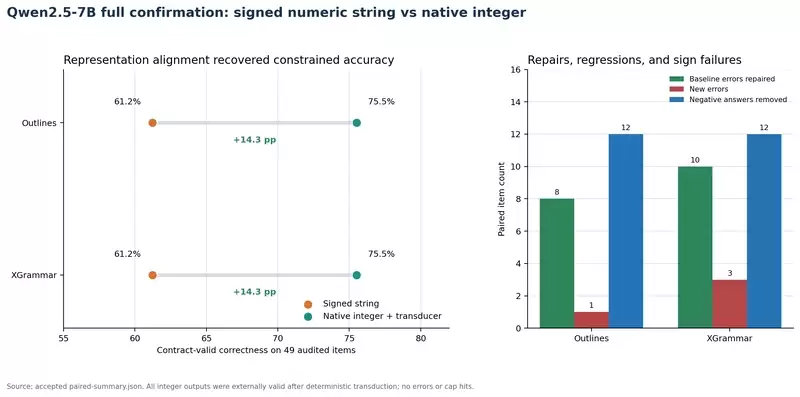
The architecture figure is generated from the implemented path. The recovery figure
is generated directly from the accepted paired-summary.json; its counts and rates
are not manually typed into the image.
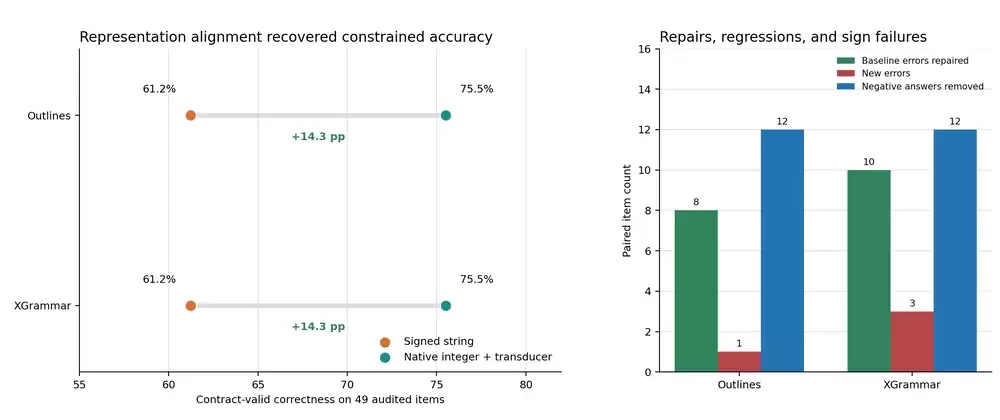
Both constrained backends gained 7 net correct answers, or 14.3 percentage points,
while preserving 100% external validity.
The original constrained gap was 18.4 points. The intervention recovered about 78%
of that gap.
The negative-answer cluster also disappeared in this matrix. Both constrained
backends moved from 12/49 negative answers to 0/49.
Aggregate improvement is not enough. A treatment can repair some items and silently
break others.
signed-string correct: 30/49integer + transducer correct:37/49difference:+14.3 pointspaired 95% interval:[+4.1, +26.5]newly correct / newly wrong:8 / 1two-sided exact paired p:0.0391
signed-string correct: 30/49integer + transducer correct:37/49difference:+14.3 pointspaired 95% interval: [0.0, +28.6]newly correct / newly wrong: 10 / 3two-sided exact paired p:0.0923
Outlines clears the conventional 0.05 threshold. XGrammar has the same point
estimate, but more discordant items, a wider interval touching zero, and a p-value
above 0.05.
The project threshold was not defined as "obtain p < 0.05 on every backend." It was
defined as meaningful recovery, majority repair, perfect final validity, and no
systematic replacement failure. Both backends passed that rule, but the uncertainty
around XGrammar belongs in the conclusion.
The cleanest comparison is not integer-constrained versus signed-string prompted.
Those conditions use different representations.
The matched comparison is integer-constrained versus integer-prompted.
All three integer conditions scored 37/49.
At the item level:
So, in this experiment, I no longer observed an aggregate semantic tax from applying
the grammar after the representation was aligned.
That is the most important engineering result of the follow-up.
The intervention did not restore every answer.
Prompted signed-string generation had 39/49 recoverable semantic correctness, while
all integer conditions had 37/49. The prompted representation difference was -4.1
points with a paired interval from -12.2 to +4.1 and exact p = 0.625.
The aligned systems also retained ordinary reasoning errors:
Representation alignment fixes a representation-associated failure. It does not
turn a 7B model into a perfect arithmetic solver.
The local Qwen2.5-0.5B smoke test exposed a separate XGrammar issue in my runner.
I initially reused one stateful Hugging Face logits processor across multiple
generations. The first item passed and later items failed with assertions. The fix was
to build a fresh processor for every generation.
The failed attempt is preserved as a diagnostic. The corrected five-item XGrammar
smoke passed 5/5 external validity, and the accepted cloud artifacts contain no such
errors.
This was a useful reminder: a structured-generation benchmark can be invalidated by
state management even when its schema and scoring logic are correct.
Within the declared setup, the evidence supports these statements:
The evidence does not establish that:
The XGrammar confidence interval touching zero is another reason to keep the claim
narrow even though its point recovery matches Outlines.
The gate is Green.
The result justifies building a bounded compiler layer with a small, auditable set of
safe transformations:
The compiler should sit above existing engines such as Outlines and XGrammar. The
goal is not to compete with their grammar execution. It is to choose a safer internal
language for the model, prove that the transformation back is sound, and preserve the
caller's contract.
Before making a general product claim, the next evidence gates are:
The repository contains the protocol, failure catalogue, schema variants,
transducer, tests, raw JSONL rows, manifests, compact traces, validation reports, and
paired summary:
The practical lesson is simple:
Do not assume the caller's wire format is the best language for the model.
Sometimes the safest way to preserve the external contract is to compile it into a
different internal representation, generate there, and transform back with code that
is deterministic enough to audit.
In this experiment, that small change recovered most of the lost accuracy without
weakening the guarantee.
大家都在看

Copyright(C) 2020-2026 jiyx.com All Rights Reserved 联系方式:[email protected]